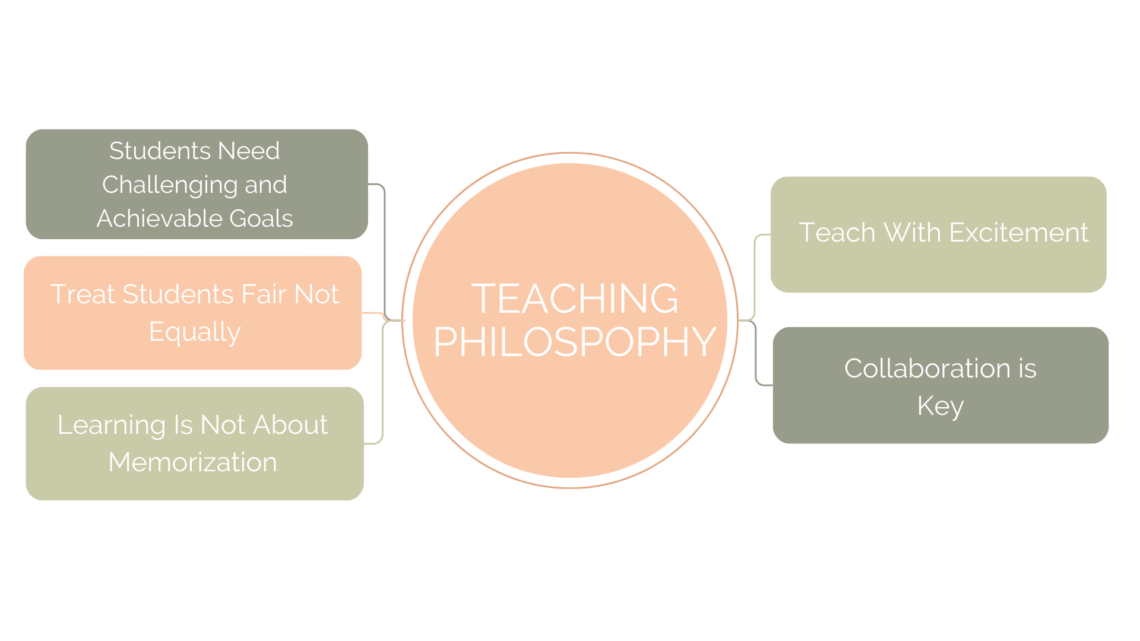
My biggest belief in teaching is that students need achievable, but also challenging goals. As a person who was (and still is) driven by reaching goals, I believe that goals are very important for growth. Setting achievable goals not only helps to challenge the students but it will also make the activities more engaging. If goals are too easy and something that students already know how to do, it can be boring and create a false sense of confidence that discourages students from trying things they may fail at first. On the other hand, when goals are set too high they can be seen as unachievable and cause students frustration that clouds their ability to learn in that moment. I learned the importance of making a goal achievable when I started coaching volleyball. As a first-year coach, I will admit that I didn’t know exactly how to run practices, help the players, or what my expectations should be. I quickly learned that I had to adjust my expectations to accommodate the skill set of my team. During the first few practices, I used drills that I was familiar with and typically did throughout my years of volleyball. Since I had been playing at a varsity level but coaching beginners, those drills were above their skill set and I was holding them to expectations they could not (at that time) reach. I started with smaller goals for drills like getting 10 continuous passes, but continued to raise it as they improved. The goal may have seemed simple at first but it forced them to remember and use the correct technique while challenging them to work on aiming the ball to a certain spot on the court. Throughout the season, I developed the skills to better understand how and when to challenge the players as well as make those challenges something they could achieve. Challenging kids can help them form a growth mindset and a belief that they can do things that may seem hard. On the other hand, if the tasks are made nearly impossible it could lead them to a fixed mindset where they no longer want to try difficult tasks because they associate it with failure.
Another important value in teaching is to treat students fair but not equally. Students in a classroom are all at varying levels of skills and it is important to be able to cater to all students, not just some. If students are treated equally it does nothing to help students who are at a disadvantage or challenge those who are above the standard. Treating students equally only helps those who are in the middle of the group or at the expected level for a “normal” student. One thing that I have seen very prevalent during my village project experience is that opportunity and achievement gaps do exist. While reading books to my group, I have kids who could be reading it all on their own, kids who could read some of it but would need help, and kids who don’t even understand what I am saying because they only know Spanish. In this case, the kids are treated equally, not fairly, so the reading only challenges those in the middle of the group who are learning how to read. However, when I was in elementary and middle school, for reading assignments we often did literature circles. Literature circles are a great example of treating students fairly because they evaluate the student’s reading level and make groups based on that in order to assign books that are an appropriate level for each group. All the students, no matter what group they are in, must still read the book, learn how to comprehend, use and discuss information, and complete the same activities or worksheets for their books. Furthermore, at higher levels group projects are a great way to play to each student’s strengths rather than picking out weaknesses. When students are collaborating with others they are able to offer up things that they are good at while others are able to help fill in areas that they are not as strong in. After being able to see the effects of the opportunity/achievement gap during my village project experience, I am a strong believer in treating students fairly, not equally.
As far as content within the classroom goes, learning is not about memorization. This might have been one of the hardest things for me to learn, but now it plays a big factor in my teaching beliefs. As a student who was always interested in science, most of the class revolved around memorizing the facts, not being able to use them in any way other than on an assessment. Learning is about the process, not the memorization. Memorization is a form of shallow thinking that only allows students to apply their knowledge over short periods of time and narrow concepts. Instead, learning needs to be continuously reinforced, practiced, and applied so students are able to gain a deep understanding of this. We should be teaching things that apply outside of the classroom such as problem-solving skills, critical thinking, connecting ideas, forming opinions, and other concepts that will apply in their lives outside of the classroom. The content of a course should be examples of using these big concepts rather than testing on the smallest, most precise details of a lesson. Recently, I have learned a lot more about creating projects and lessons that aren’t solely focused on the assessment. With our most recent games and simulations project, I was able to be creative and come up with a game about seed dispersal and think about alternative ways to assess students. Although science is oftentimes a fairly linear subject where there is one correct answer, there are multiple ways that students are able to come to that conclusion that is not a simple multiple choice or short answer test. Furthermore, especially with science, there are a lot of ways that students are able to explore different aspects such as gravity, weight, or functions. I believe that it is important to give them time to explore some of these factors before teaching them because it can be much more effective if students are able to come to the conclusion on their own. In the future, I hope to use more labs and demonstrations in my science class because I believe that is where true learning happens. In labs/demonstrations, students must think more critically and be able to connect facts that they might not have thought were connected before. Memorization is a temporary state because it is impossible to memorize everything in life, but true learning is a lasting and continuous state that can be applied and refined in different situations.
Attitude can make a big difference in the classroom. Teachers must be excited about what they are teaching and share that excitement with their students. Something that one of my former teachers told me was that “when you see someone excited about something it is hard not to be excited.” This quote has resonated with me because I think it is a simple way to help students want to engage more (it may not get them to engage but it can help them be more willing to). Enthusiasm can go a long way when it comes to the overall atmosphere of the classroom; it is one of many ways to show kids that you care about your job and the subject at hand, and is a good way to lead the kids by example. If you talk in a very monotone voice while lecturing students, it shows them that you are also bored. Showing that something is boring will make the students less likely to engage with the lesson.
Finally, collaboration is key not only among students and within a classroom but also among teachers. As a teacher, it is extremely important to be able to put your differences with others aside and be able to effectively collaborate with others whether or not you like them. You will not always get to choose who you are working with, but it is important to always keep the students’ best interest in mind and to not let personal conflicts get in the way of a student’s learning. Furthermore, working well with other teachers sets a great example for students on what effective collaboration looks like and opens up the door to do projects with other classes rather than just your class. With that being said, you don’t always have to agree with the people you are collaborating with. Pointing out struggles or bringing up alternatives helps people evaluate the options, pick the best, or even combine them to make a stronger lesson.